Cracking “Cipher’s Secret Message” on TryHackMe: A Python Walkthrough
If you are diving into the world of CTFs (Capture The Flags), you will inevitably run into custom Python encryption scripts. Today, we are…
If you are diving into the world of CTFs (Capture The Flags), you will inevitably run into custom Python encryption scripts. Today, we are…

If you are diving into the world of CTFs (Capture The Flags), you will inevitably run into custom Python encryption scripts. Today, we are breaking down the “Cipher’s Secret Message” room on TryHackMe. We are given an encrypted string and the source code used to create it, and our job is to reverse the logic to retrieve the flag.
The Challenge
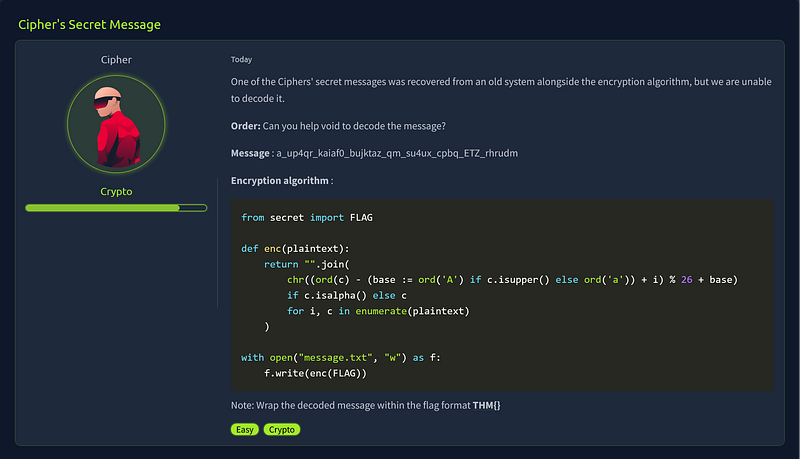
We are provided with two key pieces of information:
- The Ciphertext:
a_up4qr_kaiaf0_bujktaz_qm_su4ux_cpbq_ETZ_rhrudm- The Encryption Algorithm:
1
from secret import FLAGdef enc(plaintext):    return "".join(        chr((ord(c) - (base := ord('A') if c.isupper() else ord('a')) + i) % 26 + base)         if c.isalpha() else c        for i, c in enumerate(plaintext)    )with open("message.txt", "w") as f:    f.write(enc(FLAG))
The goal is to decode the message.
Analyzing the Encryption
At first glance, this looks like a Caesar Cipher, but there’s a twist. A standard Caesar Cipher shifts every letter by the same amount. Let’s break down the logic inside the list comprehension to see why this is different:
enumerate(plaintext): This provides both the character (c) and its position (i) in the string.-ord(c) - base: This converts the character into a 0-25 range (A=0, B=1, etc.).-+ i: This is the key. The shift amount isn’t constant; it increases by 1 for every character position. Index 0 shifts by 0, Index 1 shifts by 1, etc.-% 26: This ensures the alphabet wraps around (so ‘z’ shifted by 1 becomes ‘a’).
Essentially, this is a Progressive Shift Cipher. To decrypt it, we simply need to reverse the math.
The Solution Script
To reverse the encryption, we need to subtract the index (i) instead of adding it.
So, just change the + to — in the give script
chr((ord(c) - (base := ord('A') if c.isupper() else ord('a')) + i) % 26 + base)
Here is the logic for decryption:
P=(C−Base−i)(mod26)+Base
Below is the corrected Python script to solve the challenge.
1
def decode(ciphertext): return “”.join( # Subtract ‘i’ instead of adding it to reverse the shift chr((ord(c) — (base := ord(‘A’) if c.isupper() else ord(‘a’)) — i) % 26 + base) if c.isalpha() else c for i, c in enumerate(ciphertext) )# The encrypted message provided in the challengeenc_msg = “a_up4qr_kaiaf0_bujktaz_qm_su4ux_cpbq_ETZ_rhrudm”print(f”Decoded Message: {decode(enc_msg)}”)
How it works:
- We iterate through the ciphertext using
enumerateto get the indexi.- We check if the character is a letter (isalpha()). If it’s a symbol or number (like_or4), we leave it alone.- We apply the reverse formula:(Value - Index) % 26. Python handles negative modulo correctly (e.g.,-1 % 26becomes25), making this very robust.
The Result
Running the script produces the following output:
The Final Flag
The challenge instructions ask us to wrap the decoded message within the specific flag format.
Summary
This challenge is a great introduction to reading Python list comprehensions and understanding modular arithmetic. While standard tools like CyberChef are powerful, writing a quick 5-line script is often the fastest way to solve custom logic puzzles like this one.
Happy Hacking!